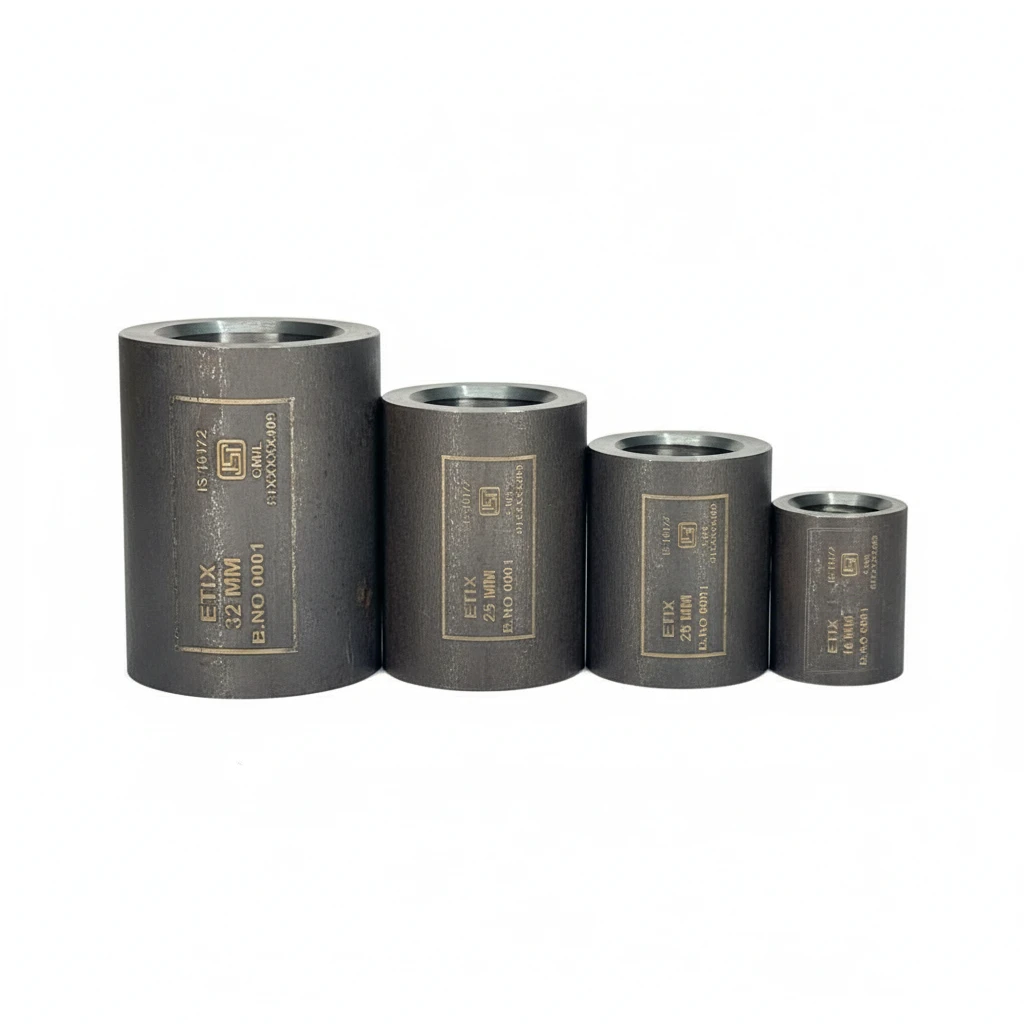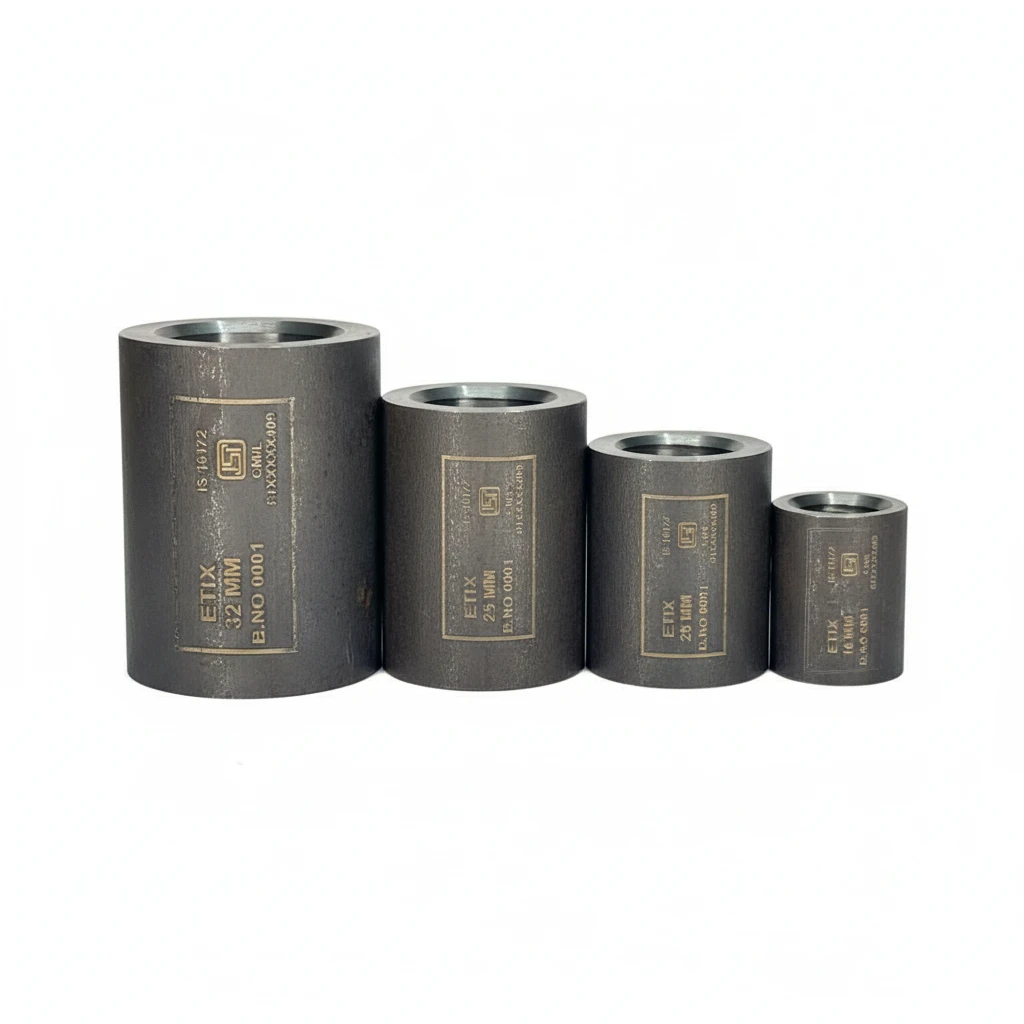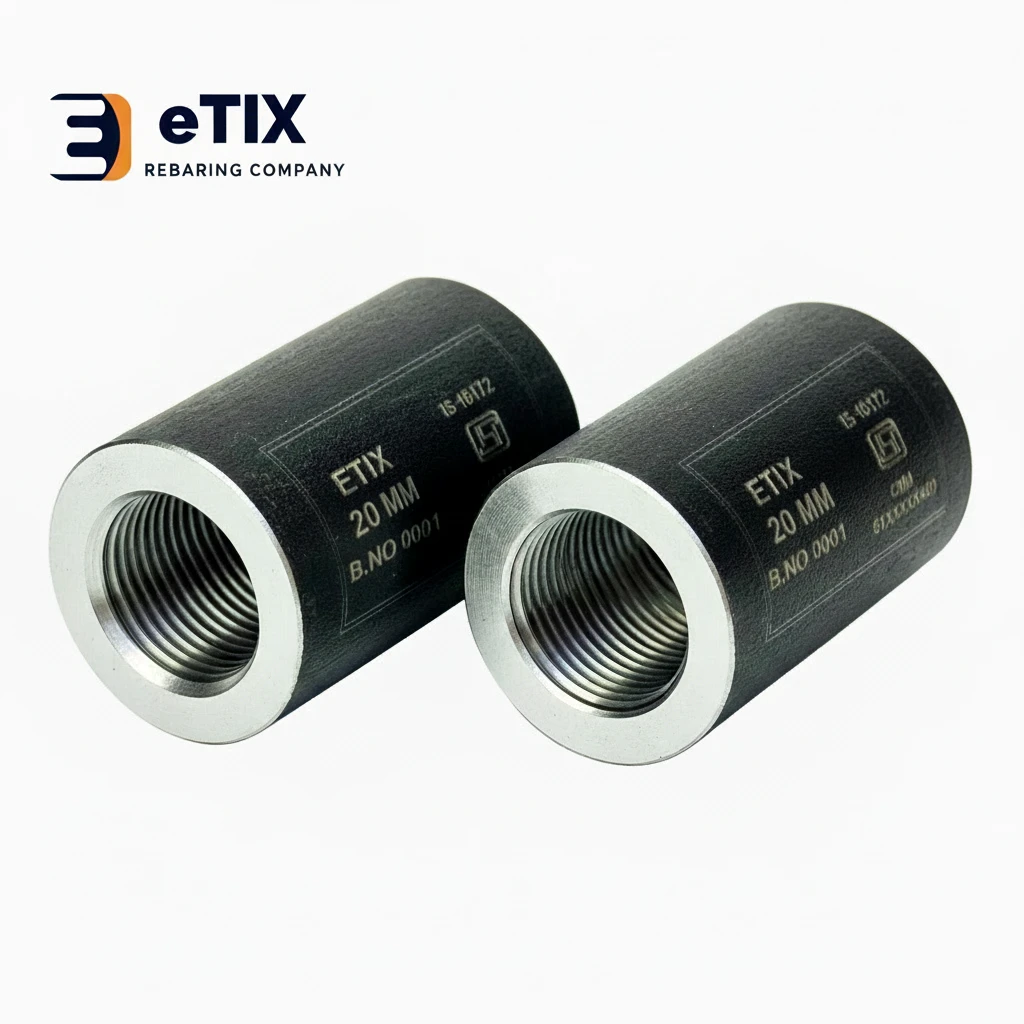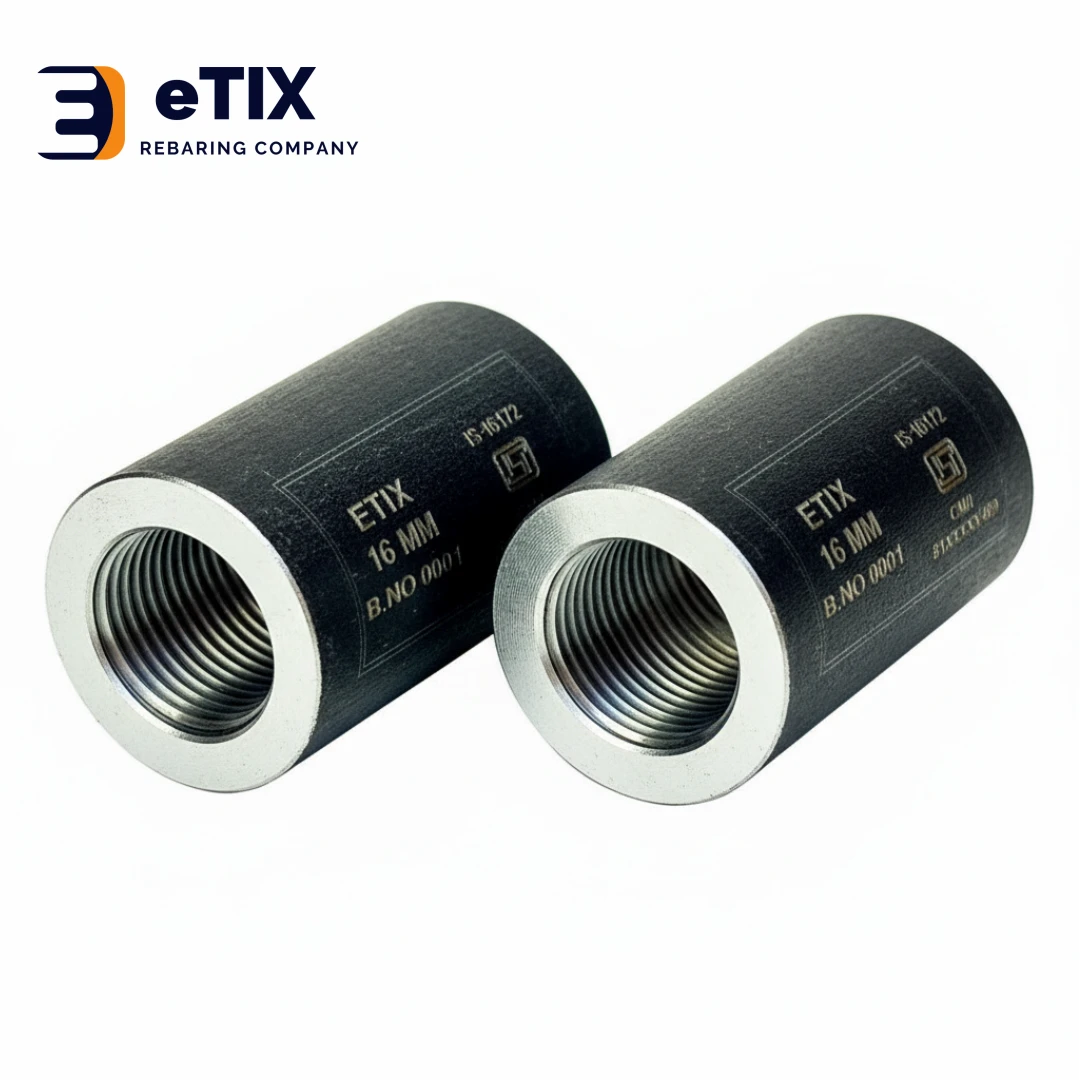
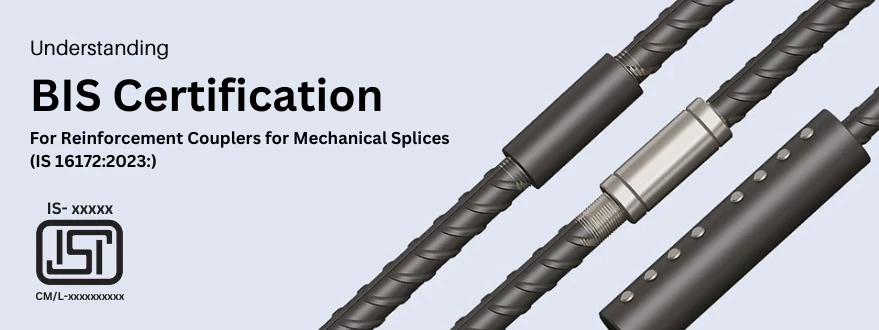
Bridges experience repeated cyclic loading from vehicles and environmental actions, so every reinforcement coupler must pass strict tensile, slip, and fatigue tests to prevent premature failure. ISI certification under standards like IS 16172 confirms that a reinforcement coupler meets defined criteria for strength, ductility, and fatigue resistance when used with TMT bars conforming to IS 1786. This certification gives bridge designers and owners confidence that the tmt bar mechanical splice coupler will behave like the parent bar during service and extreme events.
ISI-marked couplers are also checked for dimensional accuracy, thread quality, and material compatibility with Fe 500D/Fe 550D reinforcement, which is vital in bridge decks, girders, and piers. Using non-certified or poorly tested coupler reinforcement bars in these locations risks excessive slip, cracking, and high-maintenance repairs over time.
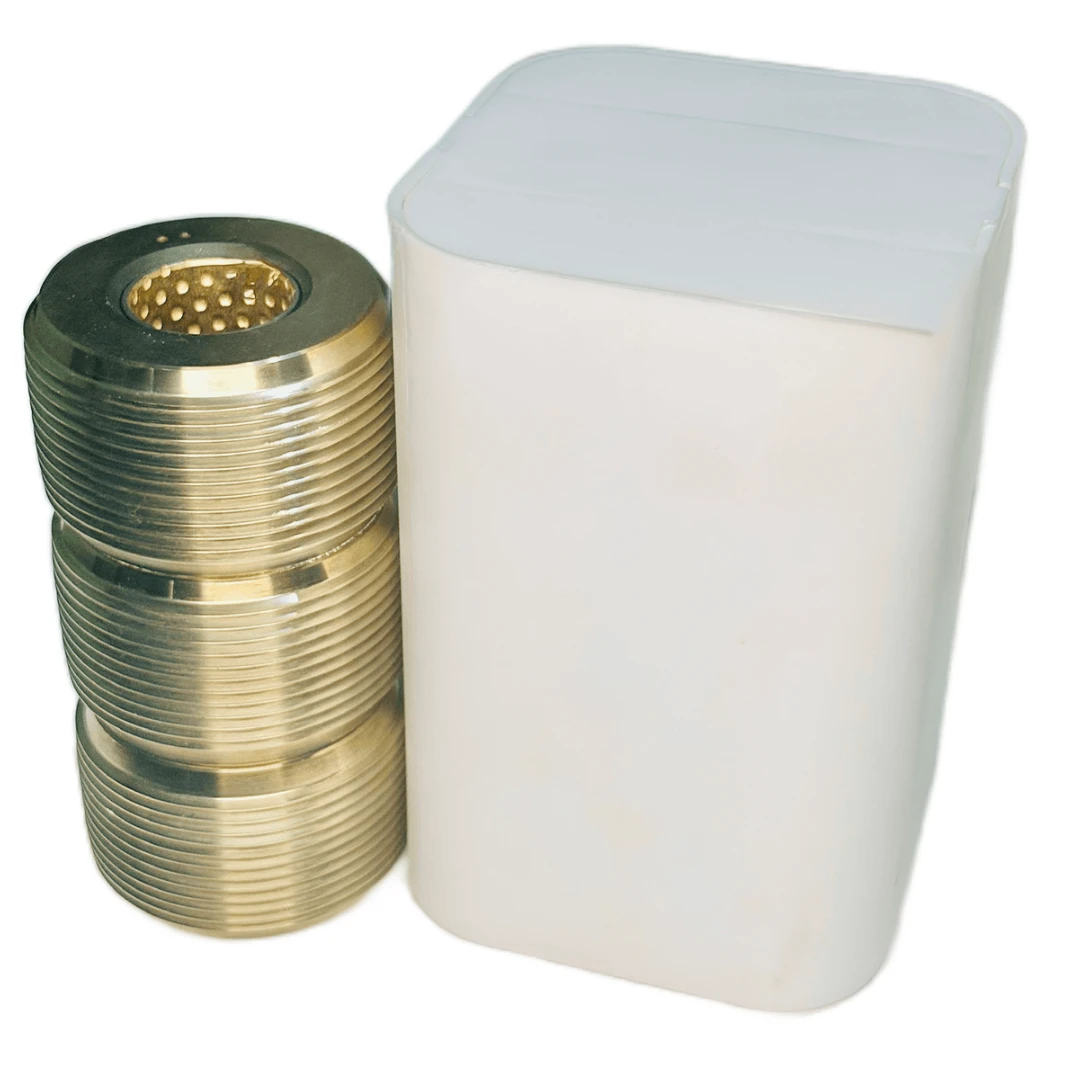
Etix ISI-certified couplers use a parallel-thread mechanical splice system that creates a continuous load path through the TMT bar and coupler, reducing dependence on concrete bond around lap lengths. When installed correctly, these mechanical splices are designed so that failure occurs in the bar rather than at the coupler, which is the ideal behaviour for critical bridge elements. civilstock+1
The precise internal threads and tight tolerances help maintain bar alignment, reducing stress concentrations and minimizing slip at the joint under repeated loading. This is especially important in bridge zones subject to high-cycle fatigue, such as deck reinforcement near expansion joints or regions with frequent braking loads.
Traditional lap splicing requires long overlaps, which increase steel congestion, complicate concrete compaction, and make quality control difficult in heavily reinforced bridge zones. Mechanical splice solutions such as Etix reinforcement couplers eliminate long laps and reduce congestion, improving concrete flow and vibration effectiveness in piers, pile caps, and deck slabs. civilstock+1
By using tmt bar mechanical splice couplers instead of laps, bridge engineers can simplify detailing, reduce rebar wastage, and achieve more predictable structural performance. This approach also makes future strengthening or extension works easier because coupler reinforcement bars allow straightforward bar extensions without breaking or exposing long lap lengths. civilstock+1
ISI-certified Etix couplers are well suited for critical bridge zones where structural integrity and fatigue performance are paramount, including pier caps, diaphragm beams, deck slabs, and continuity joints. In seismic or heavy-traffic regions, using high-performance reinforcement couplers in plastic hinge regions and high-moment zones helps maintain ductility and energy dissipation capacity.
They are also valuable where bar congestion and complex geometry are common, such as in cable-stayed bridge pylons, box-girder sections, and segmental construction, where precise alignment and compact joints are essential. In these settings, Etix couplers support faster construction cycles while protecting the long-term structural integrity of the bridge.
For the related blog image, a strong concept would be: an illustration or photo of a bridge pier or deck cross-section showing close-up details of coupler reinforcement bars connecting TMT rebars with clearly visible Etix ISI-certified reinforcement coupler sleeves. The visual can highlight a tmt bar mechanical splice coupler at mid-bar, with labels indicating “ISI-Certified Etix Coupler,” “Reinforcement coupler,” and “Mechanical splice for TMT bars,” reinforcing the message of certified safety and structural reliability in bridge construction.



You need to Sign in to view this feature

This address will be removed from this list
 english